The phono stage that adapts to the cartridge
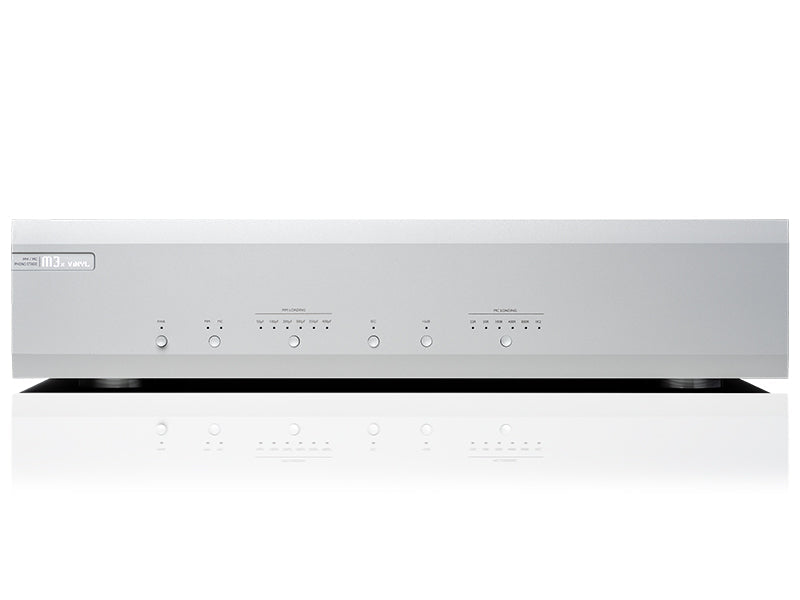
M3x Vinyl handles MM and MC cartridges with selectable loading, capacitance, gain and equalisation.
M3x Vinyl is for listeners wanting to match cartridge and phono stage correctly rather than relying on a fixed amplifier input. It accepts MM and MC cartridges and allows resistance, capacitance and gain to be selected, parameters affecting level, response and noise. It does not digitise the signal: it amplifies the cartridge's few millivolts and applies the required equalisation before sending line level to the integrated amplifier.
Key features
- Phono stage for MM and MC cartridges
- Fully discrete circuitry
- Selectable resistance and capacitance loading
- Selectable 0/+6 dB gain
- Passive, feedback-free RIAA and Decca equalisation
- RCA input and output, toroidal transformer
Why cartridge loading matters
An MM cartridge is particularly sensitive to the total capacitance of cable and input; an MC cartridge instead needs attention to resistance and gain. M3x Vinyl's adjustments allow the manufacturer's recommended values to be approached and listening refined without replacing the unit. This matters to anyone comparing cartridges, upgrading a tonearm or owning different turntables over time.
Equalisation before the amplifier
Records are cut with bass reduced and treble increased, requiring the phono stage to apply the inverse curve. M3x Vinyl provides RIAA and Decca through a passive, feedback-free network, separating correction from gain. The signal's very low amplitude also demands low noise and clean power, which makes the toroidal transformer and discrete circuit central to performance rather than ancillary features.
When it goes beyond an integrated phono input
A built-in MM input remains convenient for a simple arrangement. M3x Vinyl makes sense with an MC cartridge, specific loading requirements or when vinyl is the primary source. Its RCA output connects to any amplifier line input, never a second phono input. Black and silver finishes match M3 systems, but electrical levels, rather than the brand of adjacent components, determine compatibility.