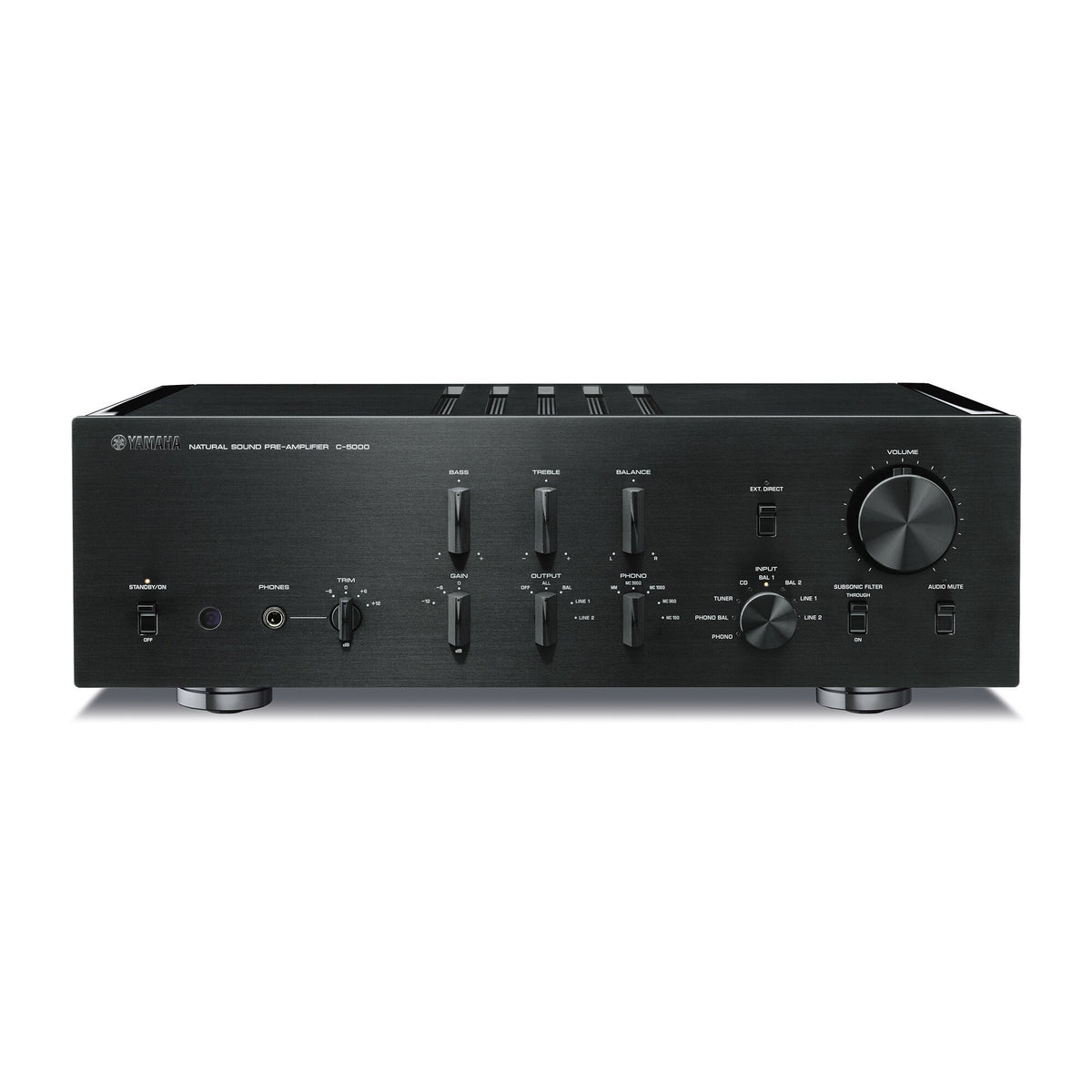
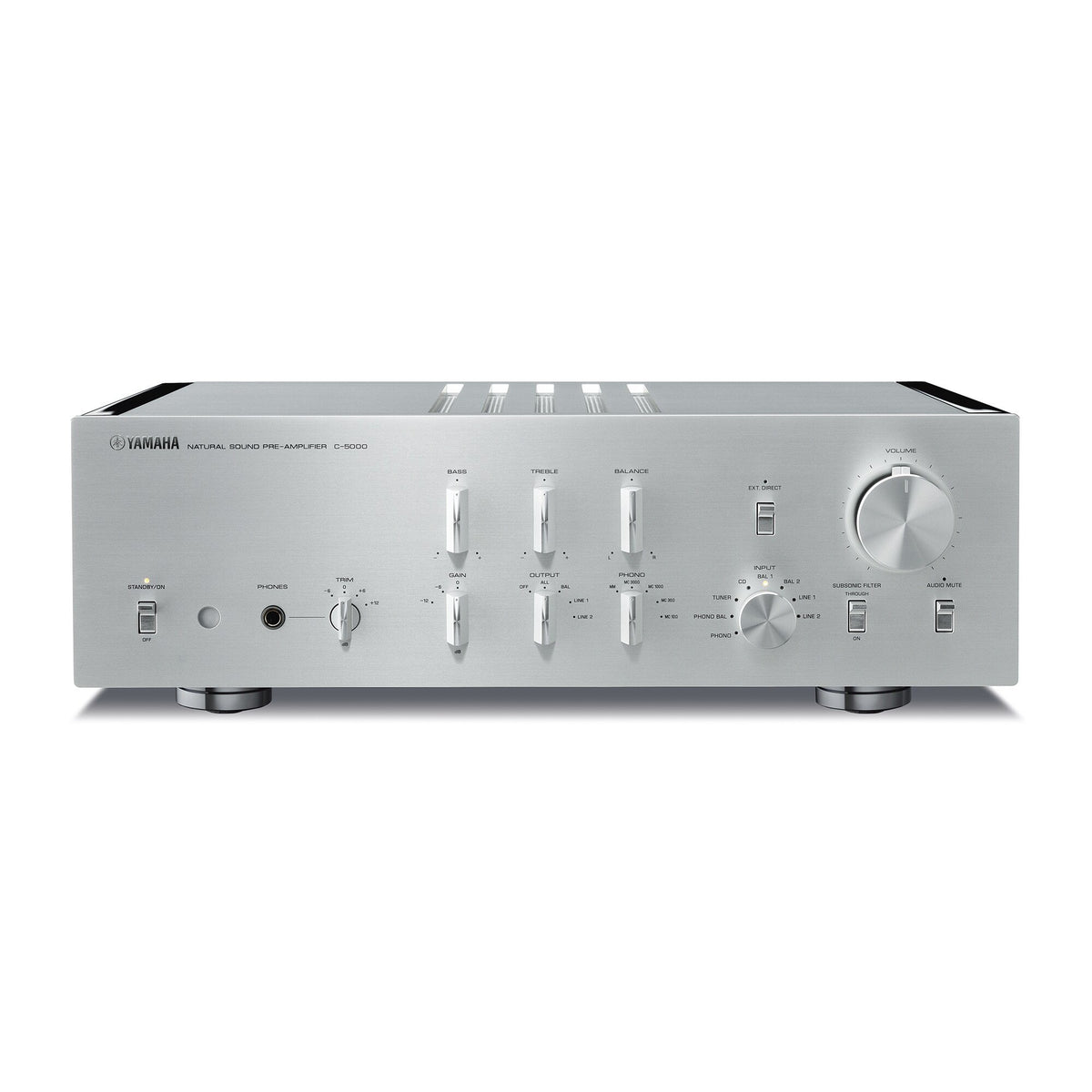
Balanced preamplification and mechanical control for the 5000 Series
C-5000 is the Yamaha 5000 Series preamplifier, designed with a fully balanced signal path, symmetrical dual-mono construction, two toroidal transformers and low-impedance architecture.
The component combines source selection, volume control and preamplification in a chassis designed to reduce electrical interference and vibration. The left and right sections are arranged as mirror images and powered by dedicated transformers, while the floating balanced topology is also applied to the phono and line stages.
Key features
- Fully balanced signal path for inputs, phono and line stage.
- Symmetrical internal construction with separate left and right circuits.
- Two toroidal transformers with copper shielding.
- Copper-plated chassis and low-impedance connections.
- Volume control with bearing mechanism for precise rotation.
- Selected components and switches for the analogue signal path.
- Solid brass feet for a stable mechanical reference.
- Designed to partner the M-5000 power amplifier from the same series.
Balanced signal path
C-5000 maintains a balanced architecture through its main stages to reduce the influence of common-mode noise and preserve signal symmetry. Yamaha applies this approach not only to the line inputs but also to the phono section and preamplifier stages, giving the analogue path a consistent philosophy from input to output.
Dual-mono construction
The left and right channels are arranged as mirror images and physically separated, reducing interaction between the two sections. The layout keeps signal-path lengths equivalent and contributes to stereo separation, while the power supply is positioned to distribute weight and magnetic-field sources in a controlled manner.
Dual toroidal transformers
Two toroidal transformers power the preamplifier sections and are shielded to limit the transfer of noise to low-level circuits. Dedicated power supplies help to keep the channels independent and provide stable reserve even when the signal passes through the phono stages, which are particularly sensitive to interference.
Low impedance and chassis
The low-impedance concept uses a copper-plated chassis, robust connections and fixing points designed to reduce parasitic resistance along the path. Construction goes beyond shielding alone: chassis, grounds and connections are treated as parts of the circuit, with the aim of maintaining a stable electrical reference for the signal.
Volume control
The large volume control uses a bearing mechanism that gives it smooth and precise rotation. Mechanical care is important because the preamplifier signal passes through a highly sensitive attenuation stage; Yamaha therefore combines the feel of the control with selected components designed to limit losses and channel-to-channel variation.
Mechanical isolation
Solid brass feet and a rigid chassis support the transformers and circuit boards on a stable base. Vibration reduction is addressed together with electrical shielding, preventing heavier components from transferring energy to low-level sections and keeping the preamplifier suitable for a high-end analogue signal chain.