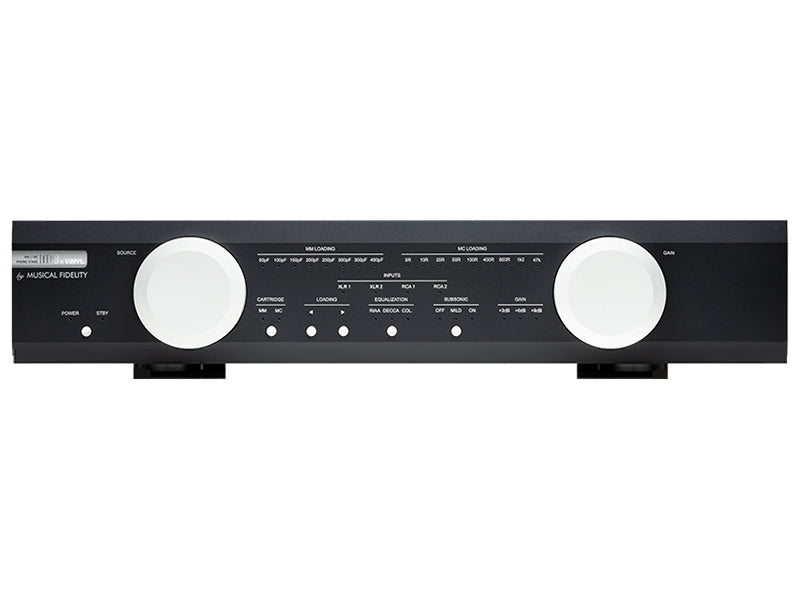
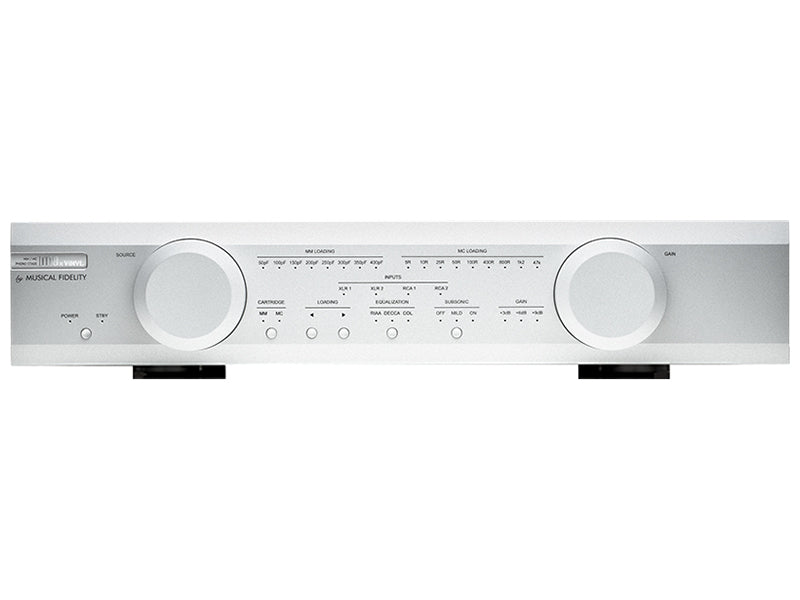
The balanced phono stage for several arms, historic curves and fine adjustment
M8x Vinyl is a balanced discrete MM/MC phono stage with four inputs, three equalisation curves and a subsonic filter.
M8x Vinyl is the flagship M-series phono stage for systems in which records, cartridges and tonearms are central. Two RCA and two XLR inputs can be configured for MM or MC; loading, capacitance and eight gain settings permit precise matching. Each polarity receives its own amplifier stage, while RIAA, Decca and Columbia curves plus a two-step subsonic filter address records from different periods and in varying condition.
Key features
- Fully balanced, fully discrete circuit
- Two RCA and two XLR inputs for MM/MC
- 40, 43, 46, 49, 60, 63, 66 and 69 dB gain
- RIAA, Decca and Columbia curves
- Two-step subsonic filter
- Encapsulated toroidal transformer, RCA/XLR outputs
Beyond M6x: balanced from the input
M6x Vinyl is discrete, but M8x doubles the path by assigning separate amplification to positive and negative poles of each channel. This requires more components and a much larger board, while allowing a balanced arm signal to remain balanced. The benefit is most relevant with very low-output cartridges and appropriate wiring.
Eight gain values avoid compromise
A typical MM and a low-output MC do not need equal gain. Values from 40 to 69 dB bring both to useful line level without unnecessarily amplifying noise or overloading the following stage. Resistance and capacitance complete matching. Begin with cartridge data and compare at equivalent levels.
RIAA, Decca and Columbia
Most modern records use RIAA, while some historic pressings follow Decca or Columbia. Selecting the correct curve restores intended balance rather than correcting by ear through an equaliser. Networks are separate and discrete. The facility matters to archives and period collections; RIAA remains normal for recent LPs.
The subsonic filter is not a tone control
Warped records, arm/cartridge resonance and vibration can produce energy below the musical band, wasting woofer travel. Two filter settings reduce this content before the preamplifier. It should be engaged only when needed because every filter changes the path. The purpose is recovering excursion and stability, not thinning audible bass.
Four inputs for a complex collection
Two turntables, a dual-arm deck or cartridges dedicated to different periods can remain connected and configured. RCA and XLR outputs suit the preamplifier; the encapsulated transformer limits radiation towards microvolt-level signals. M8x Vinyl is excessive for one fixed MM, but removes repeated compromises from an evolving collection.