A four-driver three-way design built for scale and imaging in larger rooms
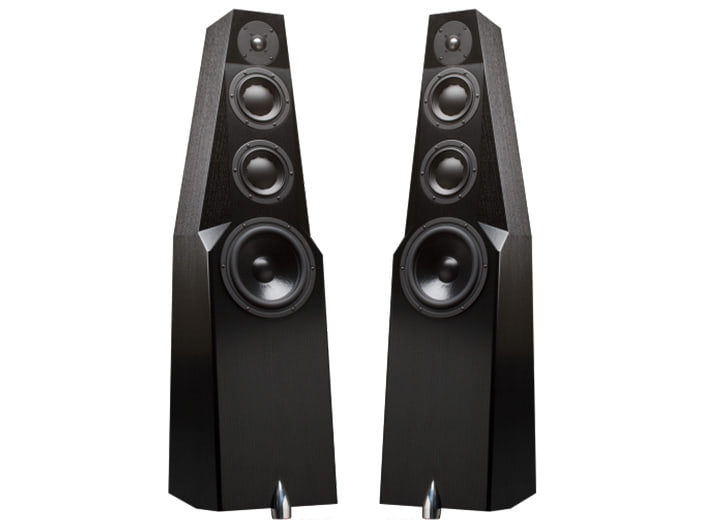
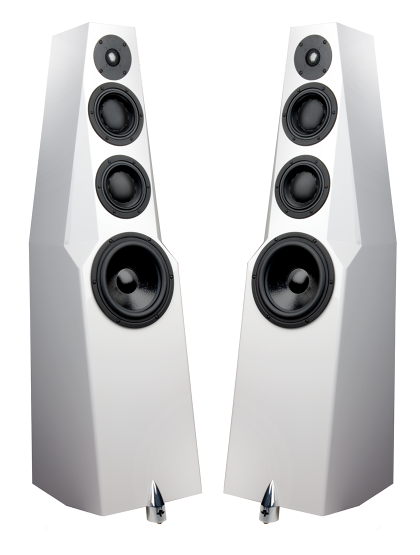
Totem Wind is a three-way floorstanding loudspeaker using an 8.5-inch woofer, two 5.5-inch midrange drivers and an alloy-dome tweeter.
Its character differs from the slimmer towers in the range: the priorities are air displacement, extension to 24 Hz and a soundstage that retains convincing scale with complex material. The geometric cabinet and twin-midrange arrangement are designed to support spatial reconstruction both on and away from the central listening axis.
Key features
- Three-way configuration using four drive units.
- 8.5-inch long-throw woofer with cast frame.
- Twin 5.5-inch midrange drivers with 3-inch voice coils.
- 1-inch alloy-dome tweeter with low-resonance rear chamber.
- Specified frequency response of 24 Hz-21 kHz ±3 dB.
- 87 dB sensitivity and 4-ohm nominal impedance.
- Recommended amplifier power from 80 to 250 W.
- Second-order crossover sections between woofer, mids and tweeter.
More radiating area for complex music
The dedicated woofer handles low frequencies, leaving the twin midrange units to cover the central part of the spectrum. This division provides more dynamic headroom than a simple two-way layout as listening level and musical density increase. A chambered tweeter completes the system without being asked to operate unusually low in frequency.
Wind or Wind Design
Wind Design does not alter the fundamental formula: it retains the same four-driver layout, sensitivity and stated bandwidth. The Design version instead adds selected parts, a dedicated crossover implementation, multilayer surface treatment and mechanical rake adjustment. Wind is therefore the more straightforward choice when the acoustic architecture matters more than those additional construction refinements.
Room and system requirements
Totem recommends substantial rear-wall spacing, roughly 0.9 m to beyond 2 m, together with generous distance between the speakers. It is therefore better suited to medium-to-large or large rooms. The 4-ohm impedance and 87 dB sensitivity favour robust amplification with strong current delivery and good control through the bass region. At roughly 112 cm high and just over 27 cm wide, the cabinet remains relatively slender for an 8.5-inch bass driver, although its depth and approximately 34 kg mass require a stable floor position and clear space around it. Acoustic loading and wall clearance should therefore be treated as part of the system design rather than as minor positioning details.