One 13 mm planar driver instead of a complex multi-driver network
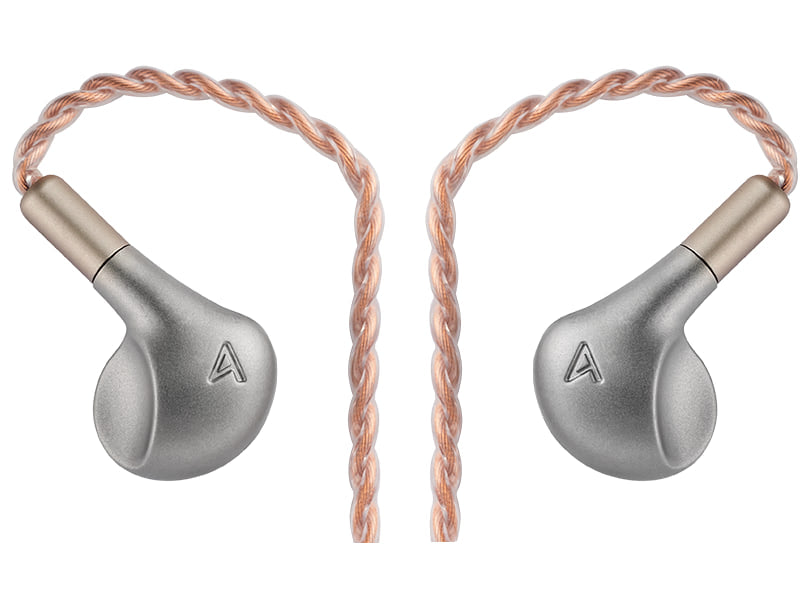
Astell&Kern Luna uses a single 13 mm unipolar planar-magnetic transducer developed with input from MADOO.
It is the most minimalist design in Lot C: rather than dividing the spectrum among many drivers and complex crossovers, one element handles the full range. The Katabiki driver is housed in titanium and paired with a 4.4 mm balanced cable combining OCC copper with silver-coated OCC copper.
Key features
- 1 13 mm Unipolar Micro Planar Magnetic driver.
- Katabiki transducer developed with MADOO involvement.
- Titanium housing.
- Specified frequency response from 20 Hz to 30 kHz.
- 5-ohm impedance at 1 kHz.
- 105 dB sensitivity at 1 kHz/1 mW.
- 2-pin connectors.
- 4.4 mm cable using OCC copper and silver-coated OCC copper.
One diaphragm across the entire audio band
With no crossover between different driver types, Luna avoids the integration issues created where multiple transducers overlap. The 13 mm planar unit handles bass, midrange and treble on its own, so temporal and tonal continuity rely on one diaphragm rather than on a network of specialised elements. Its relatively large radiating surface also provides broad bandwidth without introducing crossover points between dissimilar transducers.
Titanium with low nominal impedance
The housing uses titanium for rigidity and durability, while the 5-ohm nominal impedance makes source matching important. Sensitivity is 105 dB, so very high voltage is unnecessary; low output impedance, low noise and fine volume control matter more than sheer amplifier power.
The opposite approach to Novus, Stella and XIO
Novus uses thirteen drivers, Stella twelve and XIO ten; Luna uses only one. The difference is conceptual rather than merely numerical: Luna is aimed at listeners who prefer the continuity of a single planar transducer, whereas the other models pursue band specialisation through hybrid systems and complex crossover networks. It is also simpler to understand when matching a system: there are no interchangeable acoustic modules or multi-way networks, although a quiet low-impedance output remains important, especially with its 5-ohm nominal load and relatively high sensitivity.