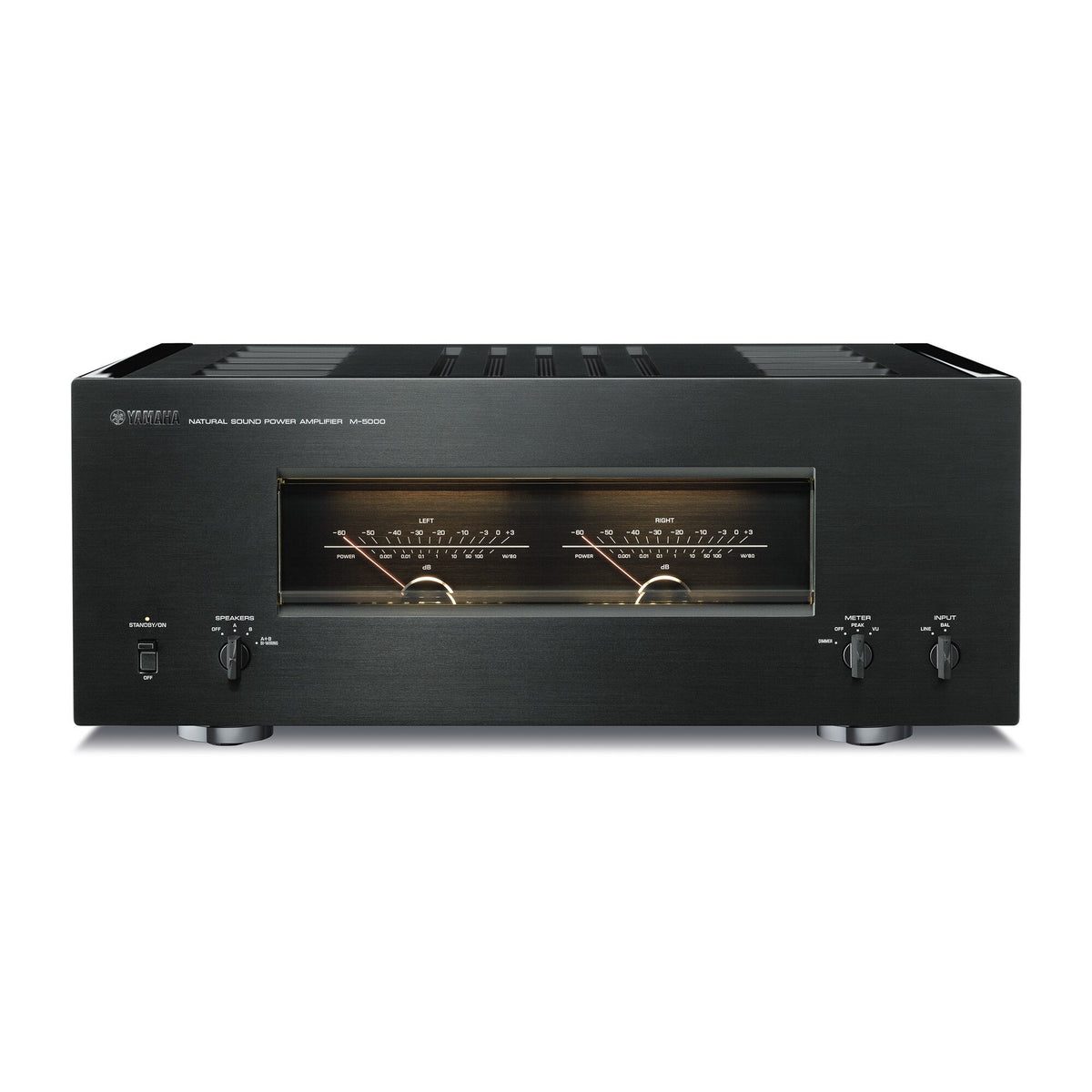
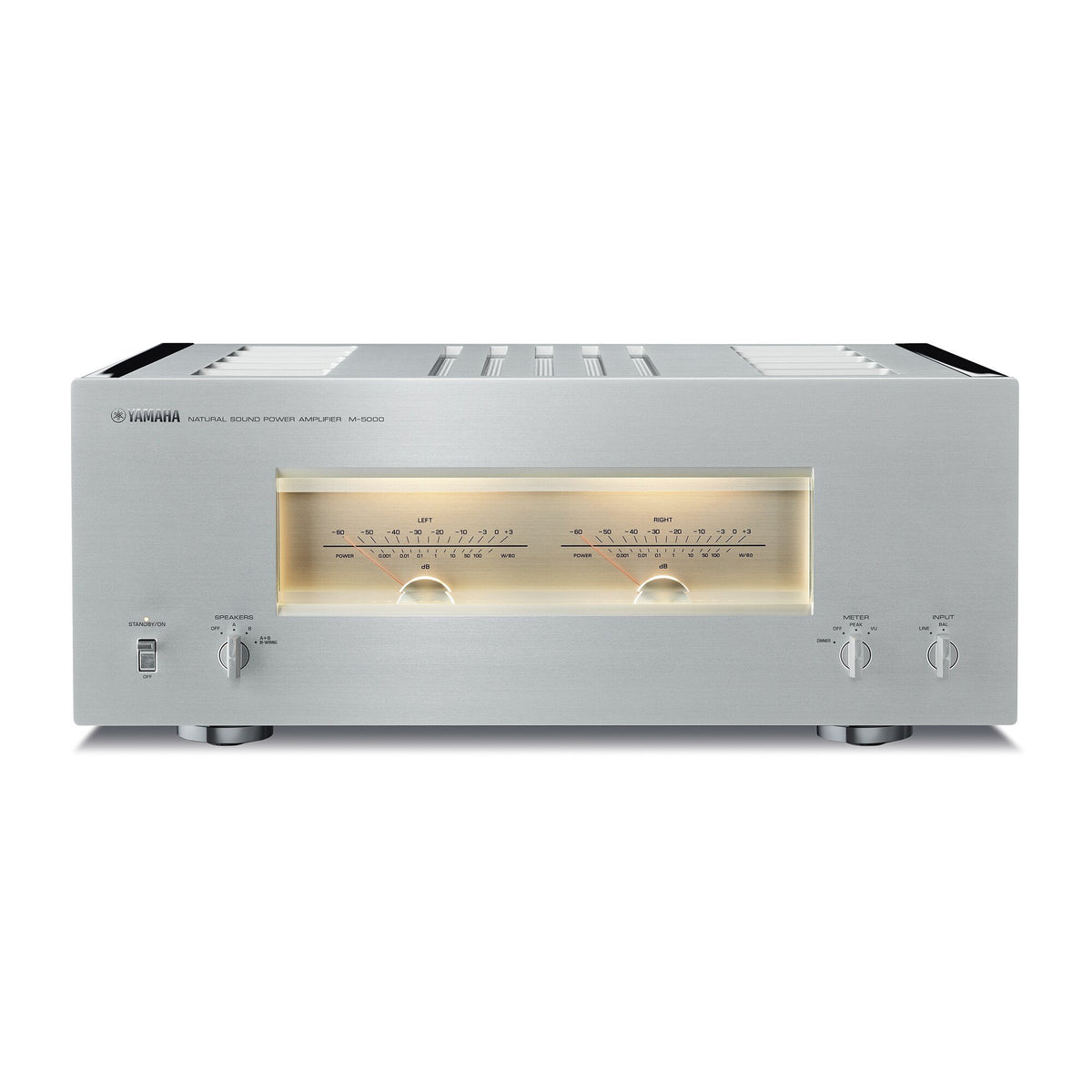
Balanced stereo power amplifier for the 5000 Series
M-5000 is Yamaha's 5000 Series power amplifier, with floating and balanced amplification, symmetrical construction, a toroidal transformer and the option of stereo or mono operation.
The design focuses on electrical and mechanical stability: the channels are arranged symmetrically, the large transformer is mounted on a brass base and the power path uses low-impedance connections. The front level meters show dynamic behaviour without altering the essential character of a power amplifier free from unnecessary functions.
Key features
- 100 W + 100 W into 8 ohms and 200 W + 200 W into 4 ohms.
- Mono configuration with output up to 400 W into 8 ohms.
- Floating and balanced amplification with symmetrical channel layout.
- Large toroidal transformer mounted on a 3 mm brass base.
- Low-impedance path with heavy-gauge wiring and screw connections.
- Brass feet usable with spikes or protective bases.
- Analogue level meters behind 7 mm-thick Asahi glass.
- Speaker terminals mounted at the top of the rear panel.
Floating and balanced amplification
The power stage is completely floating relative to ground and uses a balanced configuration from input to output. This architecture reduces the influence of ground noise and keeps the two halves of the circuit symmetrical, with the aim of improving separation, signal-to-noise ratio and transient response.
Stereo and mono power
In stereo configuration M-5000 delivers 100 W + 100 W into 8 ohms and 200 W + 200 W into 4 ohms. When used in mono mode, the declared output reaches 400 W into 8 ohms, useful in systems where one power amplifier is dedicated to each speaker or where greater reserve is required on a single channel.
Transformer and power supply
The large toroidal transformer is supported by a 3 mm-thick brass base that controls the transmission of vibration to the chassis. The power supply is positioned at the centre of a symmetrical structure, giving the two channels equivalent paths while keeping the component's weight evenly distributed.
Low impedance and wiring
Yamaha uses heavy-gauge wiring and screw connections at points where contact resistance could affect current delivery. The low-impedance concept reduces losses between the power supply and output stage and helps keep speaker drive more stable during passages with high dynamic demand.
Mechanical isolation
The brass feet can be used with spikes or protective bases, adapting contact to the supporting surface. The rigid structure and secure mounting of the heaviest components limit internal vibration, preventing the transformer and heatsinks from transferring mechanical energy to sensitive sections of the circuitry.
Level meters and construction
The two analogue level meters are protected by 7 mm-thick Asahi glass and display the dynamics of the output signal. On the rear, the speaker terminals are positioned at the top to make tightening substantial cables easier, a detail consistent with a power amplifier intended for high-end Hi-Fi installations.