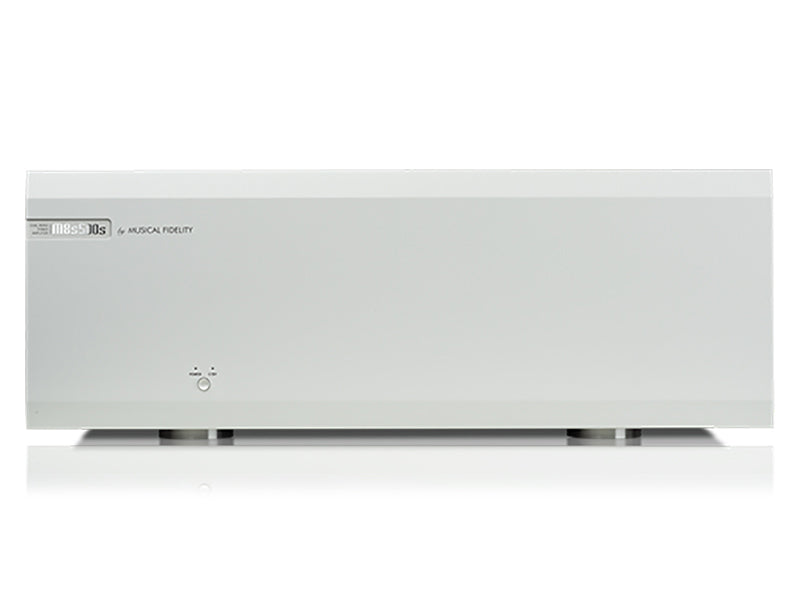
One amplifier per loudspeaker: 700 monophonic watts
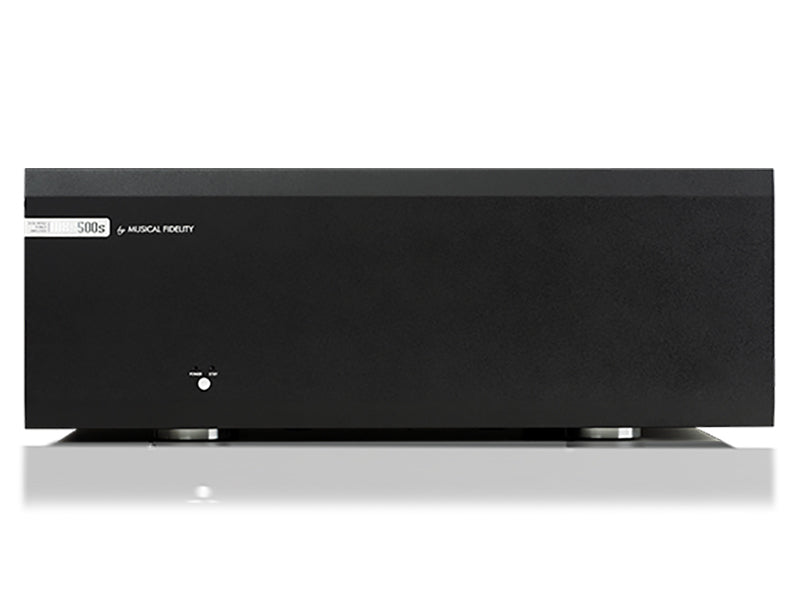
M8s 700M is a mono power amplifier sold individually: a stereo system needs two units, one for each channel.
M8s 700M amplifies one channel and is sold as a single unit; building stereo requires two amplifiers, one for the left loudspeaker and one for the right. Each unit delivers 700 W into 8 ohms and 1,300 W into 4 ohms through two internal sections operating in bridge mode. Physical separation removes shared power and chassis interaction between channels, while doubling space, sockets, weight and cabling compared with a stereo power amplifier.
Key features
- Monophonic power amplifier sold individually
- Two M8s 700M units are required for stereo
- 1x700 W into 8 ohms and 1x1,300 W into 4 ohms
- Fully balanced bridged circuitry
- One XLR and two RCA inputs, twin terminals
- 12 V trigger, black or silver finish
Why use a monoblock
One channel receives the entire transformer, filter capacity and heat dissipation of its chassis. The opposite channel lives in another unit and cannot draw current during a peak. Placing each amplifier near its loudspeaker also shortens speaker cable, moving the long run to the low-level balanced XLR connection.
Two internal amplifiers in bridge mode
M8s 700M contains two high-current sections working as a bridged mono pair. One drives the positive pole and the other the negative, increasing voltage across the load. The speaker terminal must not be treated as common ground and improvised cross-channel connections are prohibited. Installation and bi-wiring must follow the manual.
M8s PRE as the natural controller
A pair of 700M units receives left and right XLR channels from M8s PRE, which manages sources and volume. Trigger connections power both amplifiers with the preamplifier. Other balanced or RCA preamplifiers can be used when level and impedance match. M8s PRE's low output impedance helps when amplifiers sit near speakers and signal cables are long.
700M versus 500S
M8s 500S provides two 500 W channels in one chassis and costs less as a stereo system. Two 700M units add power, physical isolation and placement freedom, but require two purchases. The choice is rational for exceptional loads or a system designed around monoblocks; otherwise 500S reduces complexity while retaining immense reserve.
Power requiring responsibility
1,300 W into 4 ohms can exceed the thermal or mechanical capability of many loudspeakers. Ventilation, mains supply, terminal tightness and power sequence require control. Volume should be lowered before changing sources or cables. Headroom exists to avoid peak clipping, not to exceed driver limits.