





Description
B series
Final Audio's latest research and development achievements have evolved into a new series of cutting-edge products.
In this B series, whose name of the models (and their price) is not linked to the usual numerical hierarchy, but rather reflect the order in which the products were developed, a completely new system of cataloging products.
In-Ear Headphones – Final Audio B1
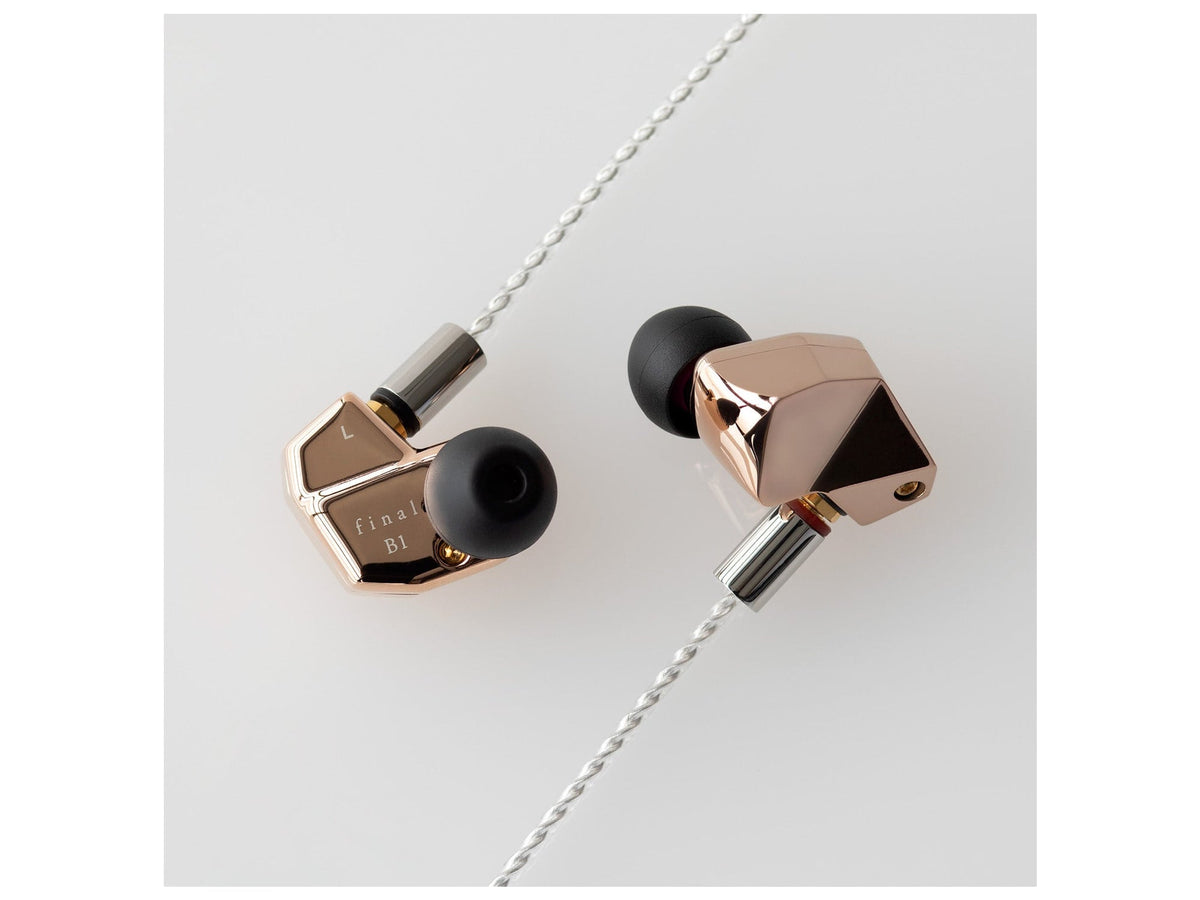
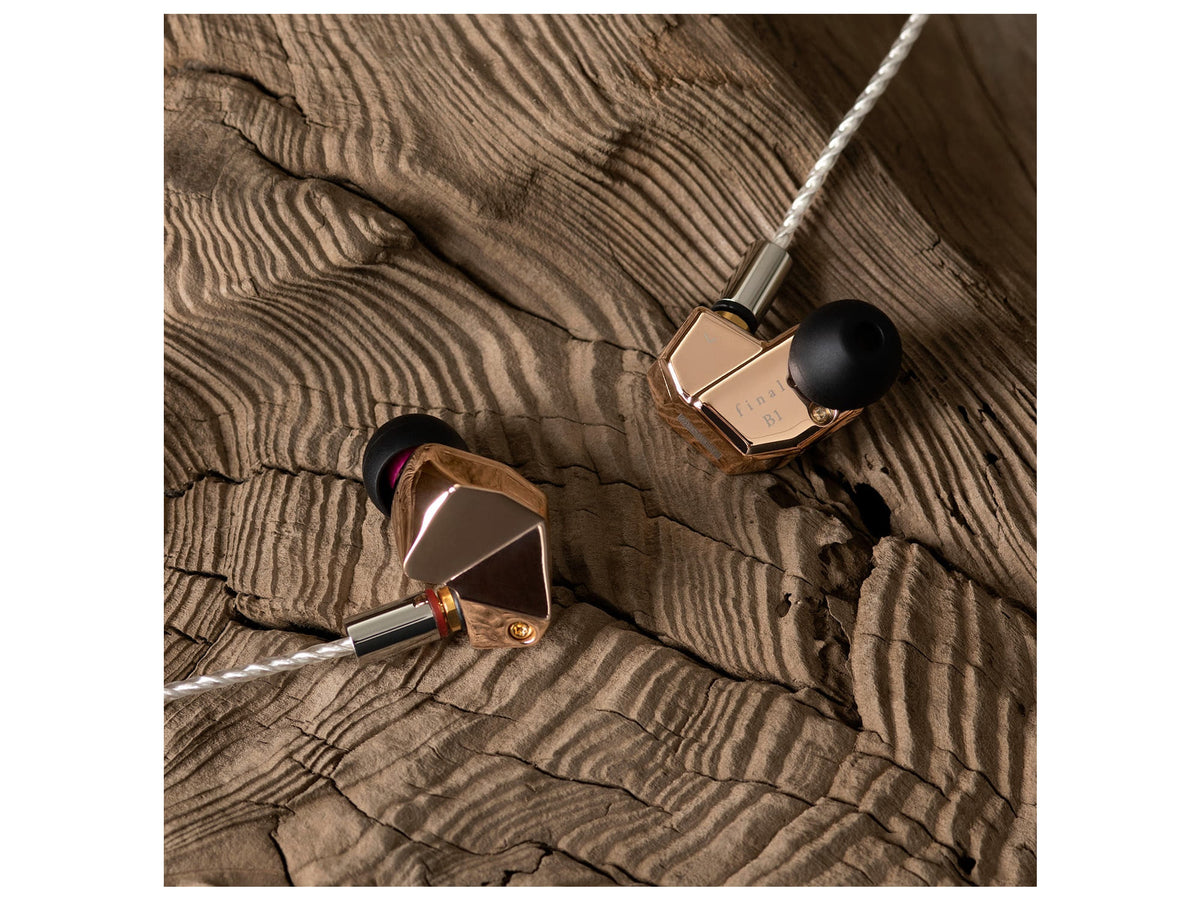
- Housing: Highly Polished Stainless Steel (Rose Gold)
- Speaker type: 1D+1BA
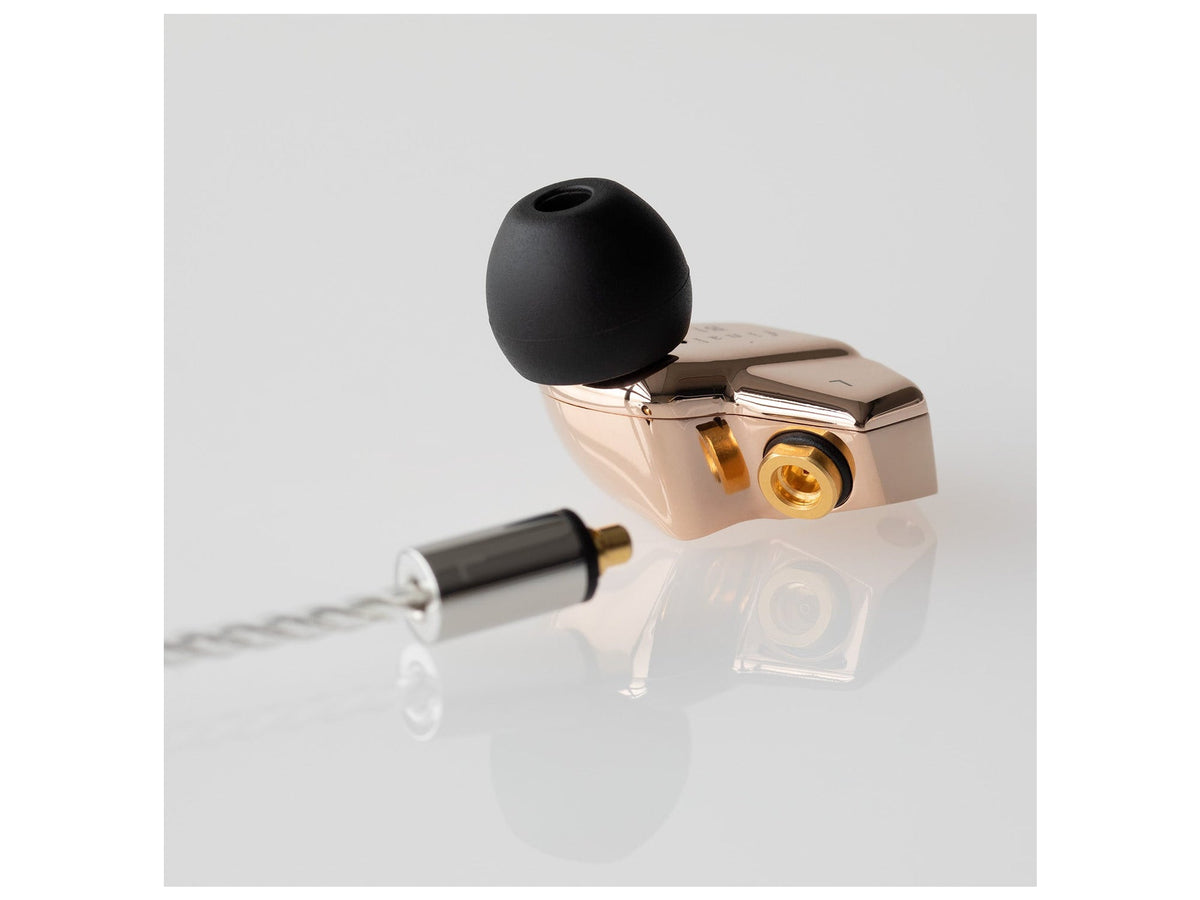
- Connector: MMCX
- Cable: Silver Plated OFC
- Sensitivity: 94dB
- Impedance: 13Ω
- Weight: 36g
- Cable length: 1.2m
- Sound Characteristics: Extremely high clarity of both vocals and musical instruments with overwhelming presence and with the same sense of presence as a live stage
B1
B1 headphones have been designed taking into account the delicate relationship between spatiality and dynamic range, all while respecting the physical characteristics of the headphones.
The voices are reproduced in such a natural way that the breathing of the performers is perceptible, as are the most subtle nuances and the timbre of each musical instrument.
Through research into the relationship between the spatiality, clarity and dynamic range of music recordings and the physical characteristics of earphones and headphones, Final learned that the deepest enjoyment of music can only be achieved by optimizing the frequency response.
B1 are designed with particular attention to the sense of reality. In the reproduction of pop and rock music, but as in soundtracks, in classical music, the B1s are optimized to give an unprecedented sense of reality with coherent reproduction and great tonal balance.

Characteristics
The sound of these headphones has been achieved by taking into account the relationship between the spatial impression and the dynamic range of the music, creating an excellent sound.
The approach was that of spatial perception. Classical and jazz recordings are performed with great emphasis on aspects of spatiality, distance, width and reverberation. Rock, pop, and many recent soundtrack recordings don't really take this into consideration. We prefer to emphasize the clarity of the reproduction, which brings the various instruments and the voice to the fore.
Another approach is dynamic range, i.e. changes in loudness over time. If the dynamic range is large, you can use volume change over time to achieve a more dynamic expression of the music. But there are certain types of music for which recordings with more limited dynamics are preferable, to allow each of the instruments and the voice to appear better before the listener's eyes.

The difference between these two ways of thinking is not about which is better, but rather about how differently music is composed and what is required of the musician. As regards classical in general, and that played by the orchestra in particular, the spatial orientation of the instruments is particularly important. Arched ones are placed closest to the audience with the percussion behind them. If the balance between the spatial orientation and the volume of each group of instruments were to be incorrect, the music would lose its meaning. For this reason, it is not appropriate for every instrument to appear before the listener's eyes. For rock and pop, on the other hand, spatiality is not so necessary and therefore there is more emphasis on clarity than spatiality.
These prerequisites are very important, especially for listening with headphones and earphones, and it is increasingly evident that it is necessary in the design phase to set goals on which aspect to prefer, in order to use the best loudspeaker and the most suitable structure for achieve the project objective.
Let's look at the graph below, where spatiality and clarity of the music are represented on the X-axis and dynamic range on the Y-axis. While the E3000 model was designed with the aim of reaching the center of the graph, the B-series is positioned below outside that area.
In other words, compared to the E series, the B series was created for listening to a specific type of music, and you may be so fascinated by it that you cannot do without it. This characterization is typical of Final products.
B1 are designed with particular attention to the sense of reality. In the reproduction of pop and rock music, but as in soundtracks, in classical music, the B1s are optimized to give an unprecedented sense of reality with coherent reproduction and great tonal balance.

Long lasting construction, with replaceable and serviceable cable

The feeling of a custom fit
The goal should be for a great fit with little sense of pressure. In Final they thought the best thing was to put the headphones on 3 different points, like on a tripod.
The green part of the drawing below (auricle) is the first support, the blue one (tragus) the second, and finally the pink (pavilion cavity) the third, the largest. The tragus fixes the outer earpiece to the inner earpiece, making it difficult to feel stress even when force is applied, and the pink section holds the earpiece in place in the pinna cavity, so it does not slide the headset out. By clearly identifying the contact points, we've made sure that almost everyone can get a comfortable fit from our headphones.
If there is no sense of pressure, the fit of the headset will feel much more comfortable and this way, you get a fit that is very similar to that of a custom headset.

MIM (Metal Injection Molding) Stainless Steel Housing
Balanced Armature Speaker and BA Dynamic Driver x2
It employs two speakers, a Balanced Armature (BA) for high frequencies and a dynamic driver for low frequencies, without using cross-over.
MMCX Connector and exclusive OFC silver coated high purity OFC cable
The MMCX connector was developed in Final using high purity OFC silver coated wires that provide a wide sound stage. These cables were developed by the Junkosha corporation for use with the "Kei" supercomputer due to their fast signal transmission speed. The insulating film is made of PFA, also developed by Junkosha*, which has used its extensive know-how through the JUNFLON® brand to create low-capacity insulating materials. The outer tube is made from PVC so it is surprisingly flexible which makes the cable extremely easy to use, as well as reducing the chances of microphonics. In addition, the MMCX connector and 3.5 mini-jack have undergone a 5,000 times bending test, up to perfecting its connection design with one that can withstand more than 50,000 bends.
* Junkosha is a Japanese company that develops and manufactures coaxial cables with the fastest propagation speed in the world, 95% of the speed of light, as well as cables for critical industries such as marine and aerospace, healthcare and energy production. These special cables require a high level of technology and are based on the use of fluoropolymers. Junkosha cables are also known under the brand name JUNFLON® and have earned the enormous trust of many engineers who need special cables.


Different colored earphones for left and right channel
One of the earpieces is grey, while the other is red; by pulling the earphone back slightly to check its color, it is easy to distinguish between left and right, even in places with dim lighting. Since the colors of earbuds of neighboring sizes are different (alternating between light and dark gray and between red and pink), it is also easy to distinguish the various sizes from each other.

Earhooks that decrease cable noise

Silicone transport container


Aging
Technical specifications
- Housing: Stainless Steel (Rose Gold)
- Loudspeakers: 1BA+1Dynamic
- Connector: MMCX
- Cable: Silver Plated OFC
- Sensitivity: 94dB
- Impedance: 13Ω
- Weight: 36g
- Cable length: 1.2m

METODI DI PAGAMENTO
Mettiamo diversi metodi di pagamento a disposizione della nostra clientela, per maggiori informazioni consulta l'informativa disponibile sul nostro sito o contatta i nostri operatori.
PAGAMENTI SICURI
I tuoi pagamenti vengono processati in modo sicuro.

